The Ten Commandments set out basic principles of how we are to treat God and how we are to treat our fellow human beings. For centuries they were at the centre of what Christians learned about their faith.
The text of the Commandments is found in two places in the Bible. In Exodus 20:1–17, God speaks these words after the people of Israel have consecrated themselves at Mount Sinai.
The Commandments
I am the Lord your God: you shall have no other gods but me.
You shall not make for yourself any idol.
You shall not dishonour the name of the Lord your God.
Remember the Sabbath and keep it holy.
Honour your father and mother.
You shall not commit murder.
You shall not commit adultery.
You shall not steal.
You shall not be a false witness.
You shall not covet anything which belongs to your neighbour.
The Apostle’s Creed is a great summary of what we hold true and sacred as Christians. Millions of Christians have been reciting it down through the ages to declare what they believe.
The Apostle’s Creed has been around in some form since the second century when it was known as the Old Roman Creed. It is a statement of faith that can be agreed to by Protestants, Catholics and the Orthodox churches. It is something that unites us all.
The Apostles’ Creed
I believe in God, the Father almighty, creator of heaven and earth.
I believe in Jesus Christ, his only Son, our Lord, who was conceived by the Holy Spirit, born of the Virgin Mary, suffered under Pontius Pilate, was crucified, died, and was buried; he descended to the dead. On the third day he rose again; he ascended into heaven, he is seated at the right hand of the Father, and he will come to judge the living and the dead.
I believe in the Holy Spirit, the holy catholic Church, the communion of saints, the forgiveness of sins, the resurrection of the body, and the life everlasting. Amen.
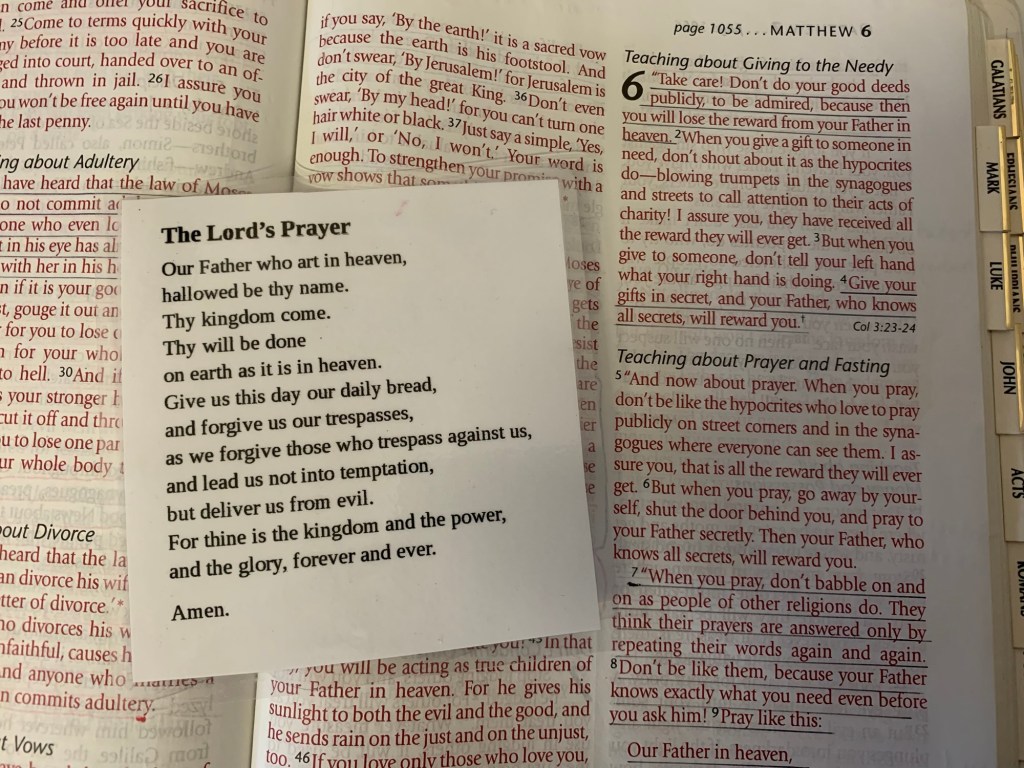
I did the same thing as I did with the Lords Prayer, I laminated it and put it in my Bible. I read it every day to memorise it. I am really glad I did.
One prayer I think is important to learn is the Lord’s Prayer. This is the prayer Jesus taught His disciples after they asked Him how they should pray.
This prayer covers all our basic needs in life. It starts by honouring God, then asks for His will, provision, forgiveness and protection. It finishes with declaring that all power belongs to Him always.
The first one is a more modern version. The second is an older version that many people know. It is the one I learned as a child.
Modern version
Our Father in heaven, hallowed be your name, your kingdom come, your will be done, on earth as in heaven. Give us today our daily bread. Forgive us our sins as we forgive those who sin against us. Lead us not into temptation but deliver us from evil. For the kingdom, the power, and the glory are yours now and for ever. Amen.
Traditional version
Our Father, who art in heaven, hallowed be thy name; thy kingdom come; thy will be done; on earth as it is in heaven. Give us this day our daily bread. And forgive us our trespasses, as we forgive those who trespass against us. And lead us not into temptation; but deliver us from evil. For thine is the kingdom, the power and the glory, for ever and ever. Amen.
I actually typed the prayer out and laminated it. I put it in my Bible as a bookmark and prayed it several times a day to learn it. Now I start every day with it.
In yesterday’s post I shared what forgiveness is not. Today I want to share what forgiveness is. It is about letting things go to God. Below is another excerpt from June Hunt’s book on forgiveness.
To forgive means to release your resentment toward your offender.
In the New Testament, the Greek verb aphiemi primarily means “to send away”—in other words, “to forgive, send away or release the penalty when someone wrongs you.” This implies that you need …
— To release your right to hear “I’m sorry”
— To release your right to be bitter
— To release your right to get even
“Do not repay anyone evil for evil. Be careful to do what is right in the eyes of everybody.”
(Romans 12:17)
To forgive is to release your rights regarding the offense.
— To release your right to dwell on the offense
— To release your right to hold on to the offense
— To release your right to keep bringing up the offense
“He who covers over an offense promotes love, but whoever repeats the matter separates close friends.”
(Proverbs 17:9)
To forgive is to reflect the character of Christ. Just as God is willing to forgive us, we are called to forgive others.
— To forgive is to extend mercy.
— To forgive is to give a gift of grace.
— To forgive is to set the offender free.
Jesus taught his disciples to pray,
“Forgive us our debts, as we also have forgiven our debtors.”
Forgiveness is not an easy subject to talk about. Sometimes it is even harder to do. In my life I have had some pretty big things that people have done to me that I just had to forgive and let go of for my own health and well being.
While working through the need to forgive I came across a book in my pastoral care training by June Hunt called Biblical Counselling on Keys to Forgiveness. It really helped me to understand what forgiveness is and what it is not.
The list below really helped me to understand what forgiveness is not and it allowed me to release my hurt and pain to God for Him to deal with at the right time.
Forgiveness is not circumventing God’s justice.…
— It is allowing God to execute His justice in His time and in His way.
Forgiveness is not waiting for “time to heal all wounds.” …
— It is clear that time doesn’t heal wounds—some people will not allow healing.
Forgiveness is not letting the guilty “off the hook.” …
— It is moving the guilty from your hook to God’s hook.
Forgiveness is not the same as reconciliation.…
— It takes two for reconciliation, only one for forgiveness.
Forgiveness is not excusing unjust behavior.…
— It is acknowledging that unjust behavior is without excuse, while still forgiving.
Forgiveness is not explaining away the hurt.…
— It is working through the hurt.
Forgiveness is not based on what is fair.…
— It was not “fair” for Jesus to hang on the cross—but He did so that we could be forgiven.
Forgiveness is not being a weak martyr.…
— It is being strong enough to be Christlike.
Forgiveness is not stuffing your anger.…
— It is resolving your anger by releasing the offense to God.
Forgiveness is not a natural response.…
— It is a supernatural response, empowered by God.
Forgiveness is not denying the hurt.…
— It is feeling the hurt and releasing it.
Forgiveness is not being a doormat.…
— It is seeing that, if this were so, Jesus would have been the greatest doormat of all!
Forgiveness is not conditional.…
— It is unconditional, a mandate from God to everyone.
Forgiveness is not forgetting.…
— It is necessary to remember before you can forgive.




 PASSIONAustralia.blog