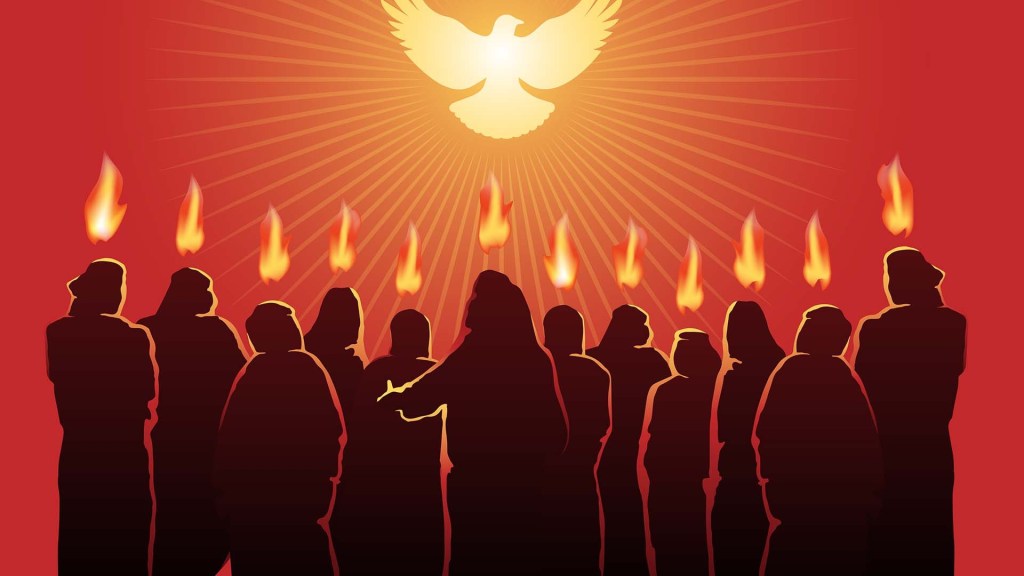
In Acts 2:1-13 we see a description of when the Holy Spirit came on the believers. It says…
[1] On the day of Pentecost all the believers were meeting together in one place. [2] Suddenly, there was a sound from heaven like the roaring of a mighty windstorm, and it filled the house where they were sitting. [3] Then, what looked like flames or tongues of fire appeared and settled on each of them. [4] And everyone present was filled with the Holy Spirit and began speaking in other languages, as the Holy Spirit gave them this ability.
It goes on to say that the people came running at the sound of a mighty wind. They wanted to know what was happening.
When they arrived they heard people speaking in various tongues as the Holy Spirit allowed them to do. The people from all nations heard the message in their own language.
The text tells us that some said they were drunk, but it also tells us that many were amazed, perplexed and bewildered. They had never seen or heard anything like it.
The part that jumped out at me was the two questions they asked. In verse 7 they exclaimed, “How can this be?” And in verse 9 they ask each other, “What does this mean?”
I think these are two crucial questions to ask when God does something new or different to what we have seen before. Rather than trying to explain things away, the questions show they we are open to learn more about God.
Being open to God and how He wants to do things is an important part of growing in our faith. The moment we shut things down and explain them away, is when we close ourselves down to growth and put God in a box.
In the section after this passage we see that Peter stands up and explains what is happening. He says they are not drunk and this is part of what was prophesied in Joel 2:28-29. He explained this is part of God’s plan of pouring the Holy Spirit on believers.
As history tells us 3000 people were added to the church that day. They were open to God, they asked the right questions and they were saved. They heard what Peter said and responded in the way God wanted.
I have learned that when God does something new or different to what I have previously seen, to ask the right questions…How can this be? And what does this mean? Then I am open to God and I do not miss out on what God is doing in the world around me.
Our Father in heaven, may your name be kept holy. May your Kingdom come soon. May your will be done on earth, as it is in heaven. Give us today the food we need, and forgive us our sins, as we have forgiven those who sin against us. And don’t let us yield to temptation, but rescue us from the evil one. For Yours is the kingdom, The power, and the glory, For ever and ever. Amen.
The Lord’s Prayer is one of the prayers of the Bible that can give us comfort and peace.
I have found that it speaks to me over and over again. Depending on how I am feeling or what is going on in my life, I find different parts become the focus.
Sometimes it is about focussing on God and honouring Him. Sometimes it is about asking for provision. And other times I might be struggling with temptation or need forgiveness.
Most of all I like that is starts and ends with God. It starts with honouring God and it ends with declaring His power and glory. This is where peace enters my soul. It puts God in His rightful place and reminds me that He is my provider and my all in all.
The title of this message is “The prayer that Jesus prayed”. Some have called this the greatest prayer of all time. Why would they call it this? Because of who prayed it – Jesus. And because what He prayed.
In the preceding chapter before Jesus prayed, He was telling the disciples about how He would be leaving them soon, the work of the Holy Spirit, and how He had overcome the world. He was preparing them for a time when they would scatter and they would not see Him any more. Jesus prayed for Himself, He prayed for the disciples and He prayed for all His future followers…including us.
Bible Reading: John 17:1-26
Point 1 – Jesus prayed for Himself (V1-5)
John 17:1 – After Jesus said this, he looked toward heaven and prayed:
I used to think that praying for yourself was a selfish thing. As a new Christian, when I listened to people pray in a group I used to critique their prayers and I would judge if they were others centred or self-centred. I would give them a score out of 10 and judge them. You will be pleased to know I don’t do that anymore!
Praying for yourself is not selfish, we all need God’s help. One of my most prayed prayers is “Help me Lord”. Jesus as the Son of God, the Alpha and the Omega, the King of kings, the Lord of lords, the one who performed many miracles including raising people to life… And He prayed for Himself. If Jesus did this, we need to too!
So, what did Jesus pray for Himself?
V1 – Jesus prayed that the Father would glorify the Son that the Son may glorify the Father
V5 – Jesus prayed that the Father would glorify the Son with the glory He had in eternity.
These two things were the bookends to Jesus’ prayer. In verse 2, 3 and 4 He reminded the Father of the authority He gave Jesus to bring people eternal life, that eternal life is found in knowing the Father and the Son, and that Jesus finished His work that the Father gave Him.
So, while Jesus prayed for Himself, it was all about bringing glory to the Father and asking that He would be restored to His former glory He had in heaven. In many ways it was about finishing all He had to do on earth.
Point 2 – Jesus prayed for His disciples (v6-19)
John 17:6-7 – “I have revealed you to those whom you gave me out of the world. They were yours; you gave them to me and they have obeyed your word. 7 Now they know that everything you have given me comes from you.
In the next section of today’s text Jesus switches His focus to the disciples or followers. Jesus said that He revealed truths from the Father to His followers. He describes them as the ones who belonged to the Father but were given to the Son (v6-8).
In verse 9 Jesus says that He prays specifically for His disciples. He is not praying for the world now, but the ones who belong to the Father and the Son. He is interceding for them because He is concerned for them. Why is He concerned? Because He is going away. Verse 11 says He is going back to the Father and they will still be in the world.
So, what did Jesus pray for His disciples?
a. V11 – To keep them in unity.
Jesus is concerned for the disciples for when He goes. He is worried that they will not stick together. Sometimes when a leader leaves, or hard times come, or when persecution happen, the people scatter and go their own way or divisions take place. Sometimes they get off track. We only have to look at Moses and the people of Israel when Moses went up the mountain to be with God. They were electing new leaders and making golden calves. Jesus wanted them to be strong and stick together. It was vital for them in their new faith and vital for their mission.
b. V15 – To keep them safe from the devil.
Jesus prayed that the Father would not take them out of the world. They were required to stay behind and continue Jesus’ mission of seeking and saving the lost (Luke 19:10), so Jesus prayed for protection. He knew the devil would come knocking and try to get them off course. We know that 1 Peter 5:8 says the devil prowls around like a lion looking for someone to devour. They would be an easy target without Jesus, so He lifted them up to the Father.
c. V17 – To sanctify them.
In verse 17 Jesus prays “Sanctify them, sanctify them by Your Word, Your Word is truth”. To sanctify means to set apart for Holy use. Jesus wanted His followers to be sanctified by the Father, so they could be used mightily in Kingdom work. As we see after the resurrection and ascension, they did some pretty amazing things. I find it interesting that Jesus said to sanctify them by Your Word. For us today the Word of God or the Bible is the key way we are sanctified. The Word and Spirit work together to make us more like Christ.
Jesus prayed out His concern for the disciples. He prayed that God would keep them unified, protect them from the devil and sanctify for them Holy use.
Point 3 – Jesus prayed for His future disciples (20-26)
John 17:20 – “My prayer is not for them alone. I pray also for those who will believe in me through their message.
Jesus now focuses His attention to the future believers. The ones who came to faith through the Apostles, right down through the ages, to us and those who come to faith after us.
Again, what did Jesus pray in this last part of His prayer? What did He think was important for us today?
a. That we would be one like the Father and the Son are one.
Jesus wanted us to be unified and one with the Father and Son. In verse 23a Jesus says, “I in them and you in me. May they be brought to complete unity to let the world know that you sent me and have loved them even as you have loved me.” Why did Jesus want us to be completely unified with each other and with the Father? So, the world may believe. There is something about being unified and loving one another that grabs people’s attention. They generally don’t see it in politics, they don’t see it in the workplace or sporting club. Church is the place where people should see true unity and love in action. When they do see true love and unity that is not of this world, Christ is revealed.
b. That we may know Jesus’ eternal glory
Verse 24 says, “Father, I want those you have given me to be with me where I am, and to see my glory, the glory you have given me because you loved me before the creation of the world.” Jesus wanted the Father to reveal His true glory to us. He wanted us to see Him as the Alpha and the Omega, the King of kings and the Lord of lords. He wanted us to see Him and the Creator who is eternal. All the things we looked at several weeks ago when we focused in on Jesus. We saw the difference seeing Jesus in His glory did to Peter who said he did not know Jesus prior to the crucifixion and then post resurrection gave his life for Jesus and His kingdom. We all need that Peter type of revelation of Jesus’ glory.
c. That we may know the love of the Father for the Son
In verse 26 it says, “I have made you known to them, and will continue to make you known in order that the love you have for me may be in them and that I myself may be in them.” If we get a glimpse of the love the Father has for the Son, there will be no doubt of Jesus’ true identity and we will love Jesus the same way too. The Pharisees and the religious leaders of the day accused Jesus of blasphemy because He called Himself the Son of God. They needed a revelation that Peter had in John 11:27, “”I believe that you are the Christ, the Son of God, who was to come into the world.” We all need this revelation.
Jesus prayed for us and all believers down the ages. He wanted us to stay strong. He prayed that we truly understand and believe that He and the Father are one, that we would see His glory and know the love of the Father and the Son.
Closing summary
Today we looked at one of the greatest prayers of all time. We saw that Jesus prayed for three main things in John 17.
Jesus prayed for Himself – He prayed that He would bring glory to the Father and the Father would restore the glory Jesus had in eternity.
Jesus prayed for His disciples – He prayed that they would be unified, protected and that the Father would sanctify them.
Jesus prayed for all believers – He prayed that we would be with the Father and Son, that we would know Jesus glory and we would know the love the Father has for the son.
Jesus showed His nail scarred hands to prove He was alive.
Matthew 28:11-15 – “As the women were on their way, some of the guards went into the city and told the leading priests what had happened. [12] A meeting with the elders was called, and they decided to give the soldiers a large bribe. [13] They told the soldiers, “You must say, ‘Jesus’ disciples came during the night while we were sleeping, and they stole his body.’ [14] If the governor hears about it, we’ll stand up for you so you won’t get in trouble.” [15] So the guards accepted the bribe and said what they were told to say. Their story spread widely among the Jews, and they still tell it today.”
One of the things I find interesting about the resurrection of Jesus is how quickly false truths were spread.
We know from the Bible and other historical sources that Jesus was raised to life on Easter Sunday. But it did not take long for the leading priests to try and change the historical view of things.
The leading priests thought they had dealt with the “problem” of Jesus. He was crucified, died and was buried. But they knew of Old Testament prophecies about the Messiah rising to life.
Because the leading priests did not think that Jesus was the Messiah, they wanted history to record that Jesus’ followers took His body in the night. They even paid off the guards!
The problem the leading priests had with Jesus is that He did not fulfil their expectations. They wanted a mighty king who would free them from Roman oppression. They wanted a king who rode in on a white horse who slayed the Romans and validated them.
But instead Jesus came as a servant King who washed feet, preached to the poor and outcastes, ate with sinners and tax collectors, healed the sick and lame, drove out demons, rode a donkey and preach the Kingdom of God.
Because Jesus did not match their image of the Messiah, they missed the One they had been waiting for, for centuries. I find this really sad.
To me this underscores the importance of having the right view of Jesus. Understanding He was the Son of God, the Messiah and the Suffering Servant the prophecies spoke of. Understanding these things determines our eternal destiny. It is just so important for us all.
One of the things I love about King David is it seems God was always on his mind. In the good times and the bad times, he cried out to God. We are so blessed to have a lot of David’s thoughts recorded in the Psalms.
Today as I read Psalm 63:1-8 I saw David’s commitment to and faith in God. He used his words so beautifully to declare his heart to God. I have highlighted some of the words that jumped out at me…
Psalm 63:1-8 NLT [1] O God, you are my God; I earnestly search for you. My soul thirsts for you; my whole body longs for you in this parched and weary land where there is no water. [2] I have seen you in your sanctuary and gazed upon your power and glory. [3] Your unfailing love is better than life itself; how I praise you! [4] I will praise you as long as I live, lifting up my hands to you in prayer. [5] You satisfy me more than the richest feast. I will praise you with songs of joy. [6] I lie awake thinking of you, meditating on you through the night. [7] Because you are my helper, I sing for joy in the shadow of your wings. [8] I cling to you; your strong right hand holds me securely.
David knew how to pour out his heart to God. He used words like “I will praise..”, “I earnestly seek…”, “My soul thirsts…” and “I cling to…” to express his feelings towards God. He was hungry for God and God was the only one who could satisfy him. I can see why God called David a man after His own heart.




 PASSIONAustralia.blog