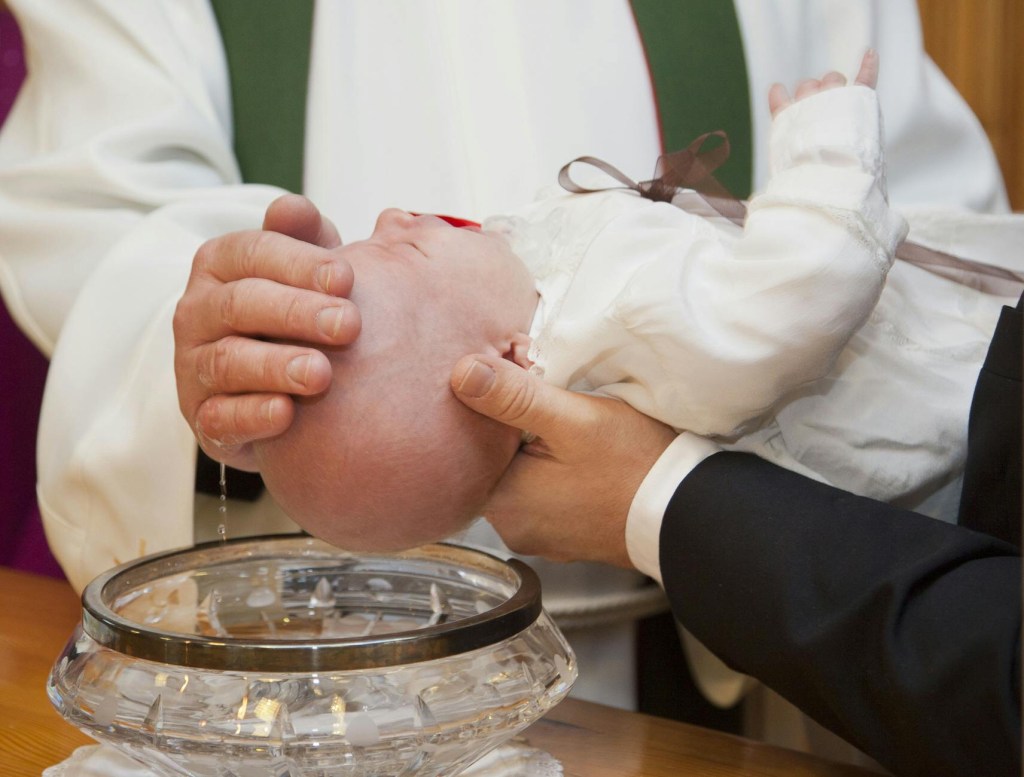
I have been reading up on Baptism afresh lately. Looking at the different churches and how they practice the sacrament down through the ages.
To give you some background. As an infant I was Baptised at our local Catholic church in Perth. My father’s family were Catholic and it was important to them that all the children and grandchildren were baptised.
From conversations I have had with my Mum I was held by the Priest at the baptismal font, prayed for and water was sprinkled/poured over my head in the name of the Father, Son and Holy Spirit.
As a child and in to my teenage years I did not attend church after baptism. However, in my early twenties I felt a drawing towards God. I had a desire to read the Bible, learn to pray and I thought about attending church. I had some friends at work who were Christians who invited me to come to their local Baptist church.
After coming to faith in Christ the topic of baptism came up. Being a Baptist church they taught believers baptism by full immersion in the water. After talking with Pastor several times to make sure I understood baptism, I was baptised during a church service.
So in essence I was baptised twice. Once as an infant and once as a believing adult. Once by sprinkling water over my head and once by full immersion. This lead me to the question – which method is right – sprinkling or full immersion?
If we go back through church history we see that both methods have always been practiced. The Catholic, Anglican, Lutheran and some Methodists practice sprinkling (or pouring) on infants. While Baptist, Church of Christ and other evangelical and pentecostals generally practice full immersion of children and adult believers.
If we look at one of the earliest writings of the church in the Didache or Teaching of the Twelve Apostles as it is known (circa 80-120AD) it gives some instruction…
Baptism
And concerning baptism, baptize in this way: having reviewed all of these things, baptize in the name of the Father, and of the Son, and of the Holy Spirit, in running water. But if you do not have access to running water, baptize in other water. And if you are not able to baptize with cold water, then baptize with warm water. But if you possess neither, pour water on the head three times, in the name of the Father, and of the Son, and of the Holy Spirit. And before the baptism the baptizer should fast beforehand, and the one being baptized and any others who are able. Call upon the one being baptized to fast beforehand for one or two days.
Brannan, R. (tran.) (2012) The Apostolic Fathers in English. Bellingham, WA: Lexham Press.
We see from this that in the very early church they practiced both forms of Baptism. Both pouring of water on the head and full immersion in a body of running water were used. The key components were water and baptising in the name of the Father, Son and Holy Spirit.
Baptism certainly is an interesting topic when you research how it has been done down through the ages and how it is practiced today. The two keys for me is baptising with water and in the name of the Father, Son and Holy Spirit.
 PASSIONAustralia.blog